
Gas Prices Are Rising: How Fuel Costs Affect Car Shipping Quotes in 2026
Why rising fuel prices matter for car shipping
Gas prices are rising again in 2026, and if you are planning to ship a car, you may be wondering: Will higher fuel prices make my car shipping quote more expensive?
The honest answer is yes, fuel prices can affect car shipping costs, but they are not the only thing that determines your quote.
Auto transport pricing is shaped by several moving parts, including distance, route demand, carrier availability, vehicle size, pickup flexibility, seasonality, and whether you choose open or enclosed transport.
As of May 17, 2026, AAA listed the national average for regular gas at $4.51 per gallon and diesel at $5.64 per gallon, compared with $3.18 for regular gas and $3.55 for diesel exactly one year earlier. Diesel matters especially in auto transport because most commercial car haulers run on diesel, not regular gasoline.
The Haulify Perspective: Lately, our team has been getting more questions about fuel costs, especially from customers shipping on long-haul routes like Florida to Michigan car shipping, snowbird moves, and cross-country relocations. The biggest misconception is that a spike at the pump automatically blows up your shipping budget. Fuel matters, but transport pricing is not based on gas prices alone.
Do Gas Prices Affect Car Shipping Costs?
Yes. Gas and diesel prices can affect car shipping costs because fuel is one of the major operating expenses for carriers.
But shipping prices do not usually move in a perfect one-to-one way. If gas rises by 20%, that does not automatically mean your car shipping quote rises by 20%. Carriers look at the full cost of moving a truck: diesel, route distance, driver time, tolls, insurance, equipment, pickup and delivery locations, and whether they can fill the trailer along that route.
A multi-car carrier can spread some of the fuel cost across several vehicles, which helps keep individual shipping costs more stable than hiring a dedicated truck for one vehicle.
Dispatch Insight
What we see on dispatch boards is simple: carriers don’t reject routes because fuel went up, they reject routes when the math no longer makes sense.
Fuel costs put the most pressure on a quote when a carrier has to drive far out of the way, enter a rural area, or take a route with limited vehicle volume. Popular interstate corridors usually give us more flexibility because carriers are already moving through those lanes. Rural area pickups and deliveries require more careful pricing because the driver has to make the trip worth the time, mileage, and diesel.
Why Diesel Prices Matter More Than Regular Gas
Most customers look at regular gas prices because that is what they pay at the pump. But in auto transport, diesel prices matter far more.
Most open and enclosed car carriers operate on diesel. When diesel prices rise, the cost to move vehicles across the country rises too. That matters most for cross-country car shipping, long-distance moves, snowbird car shipping, and military PCS car shipping.
AAA’s fuel data showed diesel averaging $5.64 per gallon, compared with $3.55 one year earlier. Recent updates from the Energy Information Administration (EIA) also confirm elevated national energy prices across major transport corridors. When a carrier is hauling a full multi-car rig over 700, 1,200, or 2,000 miles, diesel is one of the largest operating costs of the trip. If diesel rises sharply, the carrier has to factor that into whether a route is worth accepting.
How Fuel Costs are Built into a Car Shipping Quote
Fuel is usually built into the carrier’s total rate instead of being listed as a separate line item. Your quote may not say “fuel surcharge,” but fuel is still baked into the rate.
A car shipping quote is usually influenced by a balance of core variables:
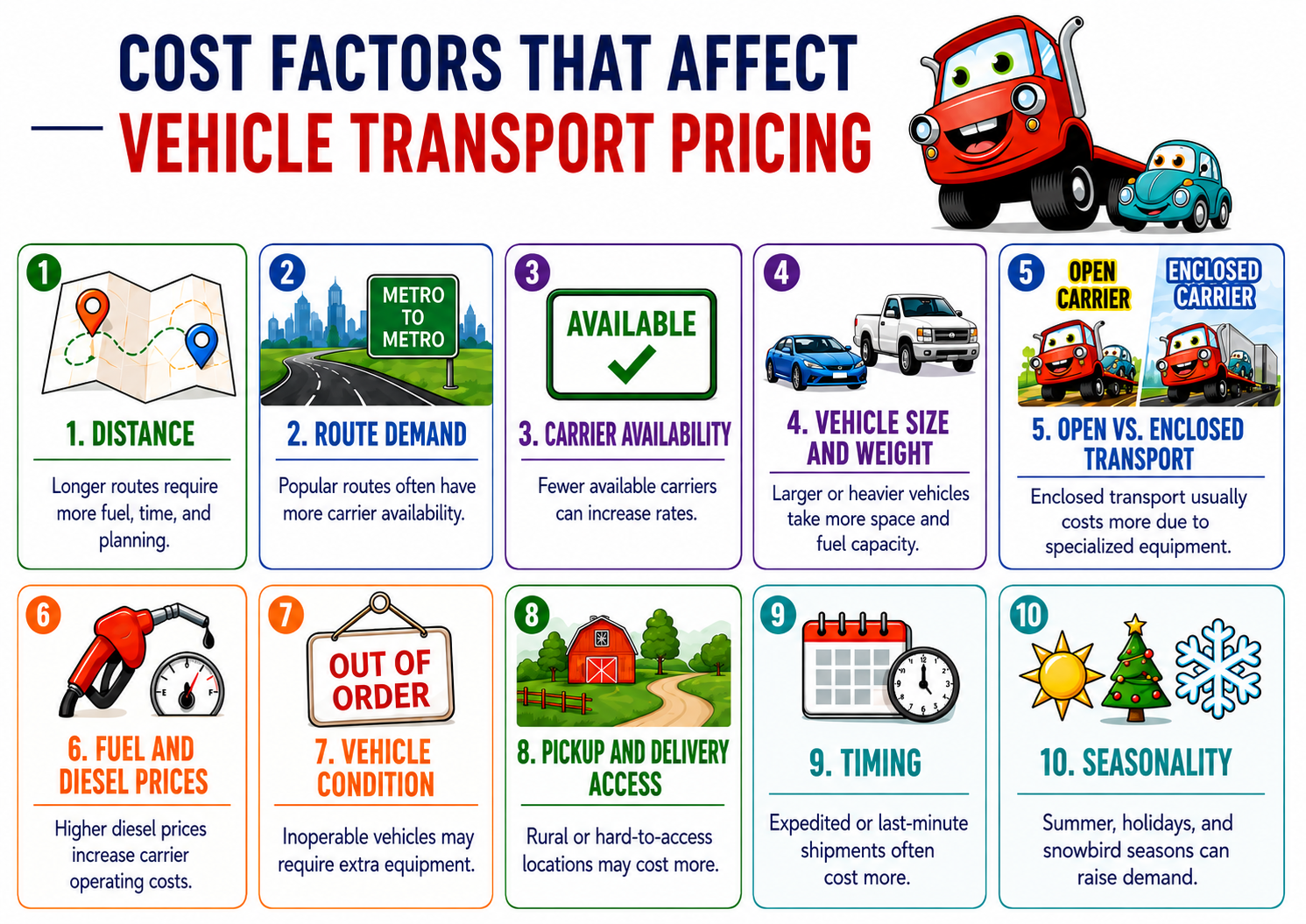
Hauly’s Advice: If you want the best price, focus on the things you can control: book early, stay flexible with your pickup window, choose open transport when it makes sense, and give accurate vehicle details from the start. A lifted truck, inoperable vehicle, or oversized SUV can change the quote, so it is always better to be upfront.
Will Car Shipping Prices Go Up This Summer?
They can. Summer is one of the busiest seasons for the auto transport industry. Families relocate before the new school year, military PCS moves pick up, college students ship vehicles to campus, snowbirds return north, and more people buy cars online or out of state.
When fuel prices rise during a busy shipping season, quotes can become more competitive. If your shipment falls near a major summer travel window, timing matters even more.
Dispatch Insight: The Summer Peak & The Holiday Crunch
According to the latest AAA travel forecast, a record-breaking 45 million Americans are projected to travel over the Memorial Day weekend alone, with 39.1 million of them hitting the asphalt by car.
This marks the busiest travel weekend on record, causing massive highway congestion on core shipping arteries like I-75 and I-10. When you combine high-traffic holiday delays with peak fuel costs, carriers face tighter schedules and less flexibility for last-minute pickups. Shipping early helps you completely avoid the stress of sitting in holiday traffic, putting extra miles on your car, and scrambling for a carrier when demand peaks.
Is Shipping Still Cheaper Than Driving Long-Distance?
In many cases, shipping can still make more practical and financial sense than driving, especially when you look at the true cost of a long-distance road trip. A lot of customers compare a car shipping quote to the cost of gas alone. But that does not show the full picture.
A long-distance drive can include:
- Gas: Fuel adds up quickly over hundreds or thousands of miles.
- Hotels: Multi-day drives often require overnight stays.
- Meals: Road travel usually means constant dining out.
- Time off work: Taking days off to drive has a real financial cost.
- Depreciation and mileage: Long trips add unnecessary miles to the vehicle.
- Wear and tear: Tires, brakes, fluids, and oil life are all affected.
- Road risk: Weather, traffic, construction, accidents, and fatigue all matter.
Real-World Example: Florida to Michigan
Consider a seasonal resident or family moving from Florida back home to Michigan, that’s a drive well over 1,000 miles.
For a recent Florida to Michigan customer, the drive looked simple at first: get in the car, head north, and save the shipping cost. But once they added two hotel nights, meals, fuel, time away from work, extra mileage, and the stress of a long I-75 drive, shipping started to make a lot more sense. Driving is not just the cost of gas. It is the cost of the full trip, plus the wear you put on the vehicle along the way.
When Fuel Prices Rise, Which Routes are Affected Most?
Not every route reacts to fuel increases the same way. Fuel-sensitive scenarios usually include:
- Long-distance routes over 1,000 miles
- Rural pickup or delivery locations
- Routes with fewer available carriers
- Expedited or guaranteed-date shipments
- Oversized, lifted, or heavy vehicles
- Specialized enclosed transport requests
- Seasonal routes with sudden demand spikes
High-traffic metro corridors usually have more steady carrier coverage, which keeps pricing more predictable. Less common routes may require a carrier to go out of the way or drive with empty trailer spots, which means the remaining vehicles on the load have to help cover the diesel cost.
Does Fuel Affect Open and Enclosed Car Transport Differently?
Fuel price shifts affect every truck on the road, but open and enclosed transport are priced differently because the equipment and capacity are different.
Open Car Transport
Open transport is the industry standard and usually the most budget-friendly option. These trailers are more common and can often carry 7 to 10 vehicles at once. Because the diesel cost is divided among more vehicles, open transport is usually the most practical option for daily drivers, SUVs, and standard trucks.
Enclosed Auto Transport
Enclosed transport usually costs more because the trailers are specialized, heavier, and carry fewer vehicles. Many enclosed trailers only carry 2 to 6 vehicles at a time. Since the fuel expense is spread across fewer vehicles, enclosed transport can be more sensitive to diesel price increases. This service is highly recommended for luxury, exotic, classic, collector, or sentimental vehicles that need extra protection from weather and road debris.
How to Save on Car Shipping When Fuel Prices are High
You cannot control diesel prices, but you can control how you book. Here are the best ways to keep your car shipping costs manageable:
- Book early: More lead time gives your coordinator more options before seasonal demand tightens.
- Stay flexible on pickup dates: A 3-to-5-day pickup window can help avoid expedited pricing.
- Choose open transport when appropriate: Open transport usually offers the best value for standard vehicles.
- Avoid peak holiday weeks when possible: Memorial Day, Fourth of July, and late-summer moving weeks are highly competitive.
- Give accurate vehicle details: Lift kits, oversized tires, non-running vehicles, and heavy modifications change the equipment needed.
- Consider a nearby metro meeting point: If safe and practical, meeting near a major highway can make the route more attractive to carriers and lower the quote.
Should you wait for gas prices to go down before shipping?
In most cases, waiting for fuel prices to drop is risky if your moving timeline is already set. Fuel prices may shift slightly, but carrier availability can change much faster. If you wait too long, you may save a little on fuel in theory but lose access to the best carrier options in practice.
FAQ: Gas Prices and Car Shipping Costs
Do gas prices affect car shipping costs?
Yes. Fuel is one of the major operating costs for transport trucks. Diesel prices matter most because commercial car haulers usually run on diesel, not regular gasoline.
Why does diesel matter more than regular gas for auto transport?
Most car carriers are diesel-powered commercial trucks. When diesel prices rise, the cost of moving vehicles across long distances rises too.
Will car shipping prices go up this summer?
They can. Summer is a busy season for relocations, military moves, college vehicle shipping, snowbird returns, and out-of-state vehicle purchases. When seasonal demand and higher fuel prices happen at the same time, quotes become more competitive.
Is it cheaper to ship a car or drive it?
It depends on the route, vehicle, timeline, and personal situation. Driving may look cheaper if you only count gas, but shipping can become more cost-effective once you include hotels, meals, mileage, wear and tear, road risk, and time off work.
Final Takeaway
At Haulify, our philosophy is simple: we do not believe in giving customers an unrealistic low number just to win the lead, only to surprise them later with a price correction or “fuel adjustment.” We would rather explain how the pricing works upfront so you can make a clear decision with realistic expectations.
If you are relocating, buying a vehicle out of state, helping a student move, planning a military PCS move, or wrapping up a seasonal route, fuel prices are worth paying attention to, but they should not be the only thing guiding your decision. The best strategy is to plan early, understand your route, and compare shipping against the full cost of driving.
Ready to see what your specific route looks like?
Connect with the Haulify team, get a transparent quote, and let’s make your next move easier.
Written by the Haulify Team. This guide was compiled using current 2026 fuel-price data, logistics analysis, and real-world auto transport dispatch experience to help consumers navigate long-distance vehicle shipping with clarity.