

Auto Transport Broker vs. Carrier
When you request a car shipping quote, the company helping you arrange transportation may not own the truck that eventually picks up your vehicle.
That is normal in auto transport because brokers and motor carriers perform different roles.
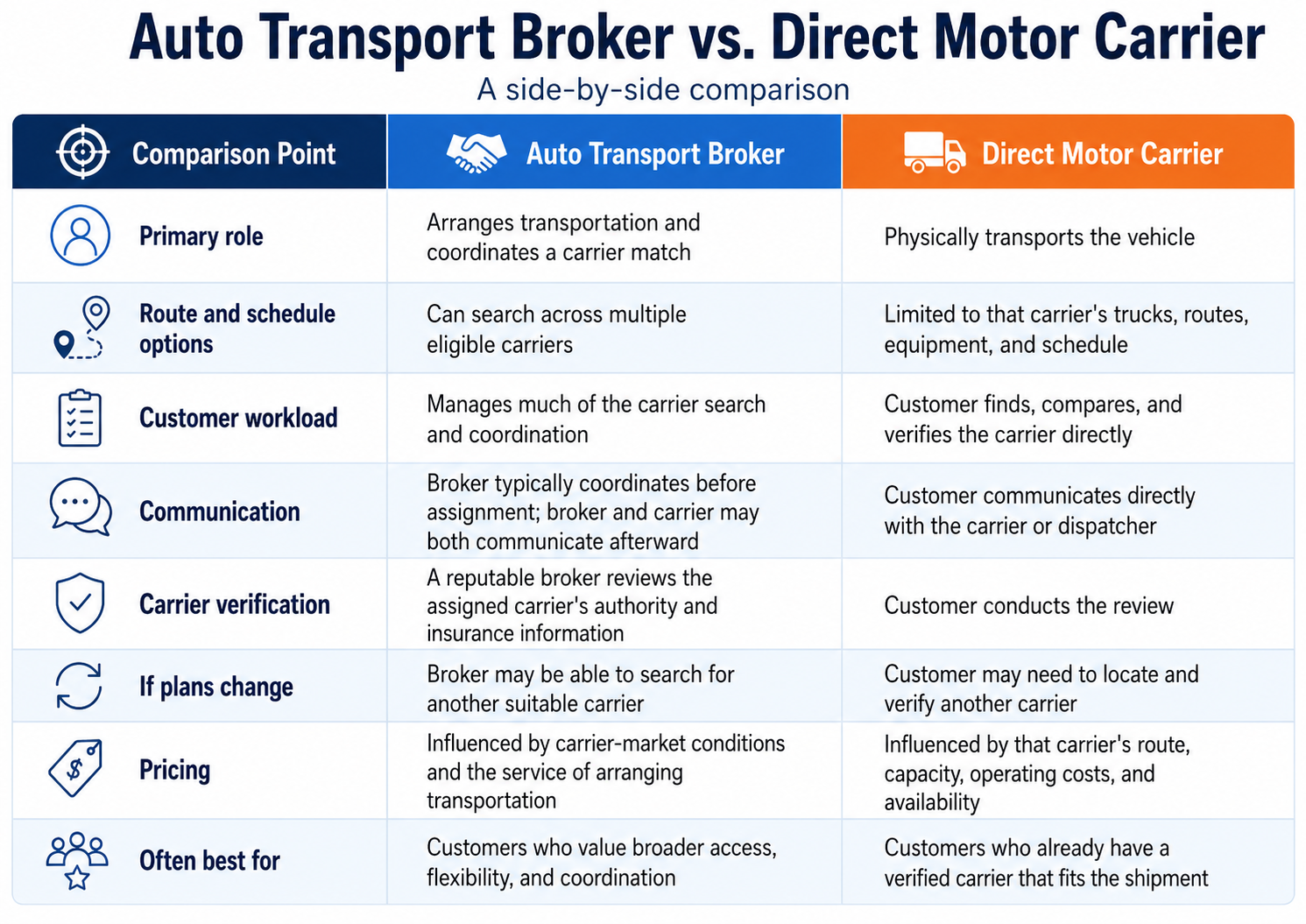
A motor carrier physically transports your vehicle. An auto transport broker arranges the transportation and coordinates a carrier for you.
So, is it better to use an auto transport broker or book directly with a carrier?
Booking directly with a carrier can make sense when you have already found a properly authorized and insured carrier that serves your exact route and fits your schedule. A reputable broker is often more practical when you want access to more carrier options, help with coordination, or another search option if plans change.
Neither option is automatically cheaper, faster, or safer. The better choice depends on your route, vehicle, timing, the carrier's availability, and how much of the search and coordination you want to handle yourself.
Haulify is a federally registered auto transport broker. We coordinate vehicle transportation with authorized motor carriers rather than owning or operating the trucks that physically transport customers' vehicles. In this guide, we'll explain how both options work, where each has advantages and limitations, and how to decide which approach makes the most sense for your shipment.

Simple and Reliable
Nationwide Car Shipping
Don’t Drive It. Haulify It!
Nation’s Best Choice for Auto Transport
Get a Quote
Key takeaways
- A carrier transports the vehicle. It provides the truck, trailer, driver, and physical transportation.
- A broker arranges the transportation. It coordinates the shipment with an authorized motor carrier.
- Booking directly can make sense when you already have a verified carrier that serves your route and schedule.
- A broker can search across multiple carrier options instead of relying on one carrier's availability.
- Direct booking is not automatically cheaper, and using a broker does not automatically guarantee faster service.
- Whether you use a broker or carrier, verify the company and the assigned carrier through FMCSA records before shipping your vehicle.
Table of contents
- What is the difference between an auto transport broker and carrier?
- Auto transport broker vs. carrier comparison
- When does booking directly with a carrier make sense?
- When is an auto transport broker the better choice?
- Is booking directly with a carrier cheaper?
- What happens if a carrier becomes unavailable?
- How to verify an auto transport broker or carrier
- Auto transport red flags
- How Haulify makes auto transport simpler
- Frequently asked questions
What is the difference between an auto transport broker and carrier?
The simplest distinction is:
The broker arranges. The carrier transports.
An auto transport broker helps connect a customer with a motor carrier that can perform the shipment. Depending on the broker and shipment, that can include:
- Collecting your vehicle, route, timing, and contact information
- Estimating the transportation price based on current market conditions
- Searching for carriers that fit the route and requested pickup window
- Reviewing carrier authority and insurance information
- Coordinating carrier assignment
- Providing carrier and pickup information
- Helping organize communication around the shipment
- Searching for another carrier option if an assignment changes, subject to availability and the broker's terms
Instead of contacting individual carriers one at a time, you provide your shipment information to the broker, and the broker manages much of the carrier search.
A broker does not physically load, drive, or deliver the vehicle when acting solely as a broker.
A motor carrier performs the transportation. It provides the truck, trailer, driver, and equipment used to move your vehicle from pickup to delivery.
At pickup, the driver normally inspects the vehicle and documents its condition on a Bill of Lading. You should inspect the vehicle again at delivery before signing the final paperwork.
Can a company be both a broker and carrier?
Yes.
Some companies hold both broker and motor-carrier authority. They may transport certain vehicles using their own equipment and arrange other shipments through third-party carriers.
If a company operates as both, ask which role it will perform for your specific shipment.
Is a dispatcher the same as a broker?
Not necessarily.
A dispatcher generally helps coordinate a carrier's loads, routes, drivers, or communication. The word "dispatcher" by itself does not establish broker or motor-carrier authority.
What matters is the legal entity accepting your order and the motor carrier physically transporting your vehicle.
Auto transport broker vs. carrier comparison
When does booking directly with a carrier make sense?
Booking directly with a carrier can be a good option when the carrier already fits your shipment.
Direct booking may be the better fit if:
- You already know which carrier you want.
- You have verified its authority and insurance information.
- The carrier regularly serves your route.
- It has space during your required pickup window.
- Its equipment fits your vehicle.
- You are comfortable managing the paperwork and verification yourself.
- You have a backup plan if its truck becomes unavailable.
One advantage is direct truck-level communication. You are dealing with the company physically transporting the vehicle or its dispatcher.
A carrier may also offer an efficient rate if your vehicle fits naturally into a route it already plans to run.
The limitation is that one carrier can only offer the trucks, routes, equipment, and schedule it currently has available.
When is an auto transport broker the better choice?
A reputable broker can be especially useful when you have not already identified a carrier that fits your shipment.
A broker may be the better fit if:
- You still need to find a carrier.
- You want access to multiple carrier options.
- Your route or timing requires more flexibility.
- You want help evaluating carrier credentials.
- You do not want to contact and compare carriers individually.
- You want one company coordinating the search and shipment details.
- You would benefit from another carrier search if the original assignment changes.
The primary advantage is access.
A broker is not limited to a single fleet. That can be valuable when your shipment involves a narrow pickup window, seasonal demand, a difficult location, special equipment, or a route that one carrier does not regularly serve. Broader access does not mean every carrier is available or that every carrier works with every broker. It simply gives the broker more potential options to evaluate than relying on one carrier's schedule.
That does not mean a broker can guarantee a particular truck, price, or pickup date. Carrier availability, equipment, route coverage, and broker-carrier relationships still vary.
Is booking directly with a carrier cheaper?
Sometimes, but not always.
A direct carrier may offer an efficient rate when your shipment fits its existing route and schedule. However, direct booking does not automatically eliminate costs or guarantee a lower price.
A broker can compare carrier options while handling the search and coordination. The broker's service may include reviewing carrier information, coordinating assignment, and helping manage changes. A direct carrier may not charge a separate broker fee, but its rate still reflects its own operating costs, route economics, capacity, and availability.
Auto transport pricing depends on the complete transportation arrangement, including:
- Distance and route
- Pickup and delivery locations
- Access for a large transport truck
- Pickup timing and flexibility
- Seasonal and directional demand
- Carrier capacity
- Vehicle size and weight
- Vehicle operability
- Open car transport or enclosed transport
- Specialized or expedited transportation
- Fuel and operating conditions
The better comparison is the complete transportation offer, including actual carrier availability, services provided, communication, contract terms, and what happens if the original plan changes.
For a more detailed pricing breakdown, see how car shipping costs are calculated.
Be cautious about unusually low quotes
The lowest initial quote is not always the lowest workable transportation price.
A quote may fail to reflect current carrier demand, vehicle size, difficult pickup access, an inoperable vehicle, or a narrow pickup window.
Before booking, ask:
- Is this an estimate or a confirmed price?
- What shipment details were used to calculate it?
- What could cause the price to change?
- Would I need to approve a revised price?
- When will I be charged?
- What are the cancellation terms?
A realistic quote should make sense for the shipment and current carrier market, not simply be the lowest number you receive.
What happens if a carrier becomes unavailable?
Carrier assignments can change because of:
- Mechanical problems
- Driver availability
- Schedule changes
- Weather
- Road closures
- Previous shipment delays
- Other operational disruptions
If you book directly and your carrier can no longer perform the shipment, you may have to find and verify another carrier yourself.
When you work with a broker, the broker can potentially reopen the search and look for another suitable carrier. That flexibility is one of the clearest practical differences between the two models.
However, using a broker does not guarantee that another carrier will immediately be available, that the price will remain identical, or that the same pickup window can be maintained.
Before booking, ask what the broker's agreement says about carrier reassignment, price changes, cancellation, and customer approval.
How to verify an auto transport broker or carrier
You do not need to search through a long list of government websites.
For most consumers, the verification process can be narrowed down to a few important checks.
1. Ask which role the company will perform
Ask whether the company is acting as a broker, motor carrier, or both.
Request its legal business name, DBA if applicable, MC or docket number, and USDOT number when applicable.
2. Check the FMCSA SAFER Company Snapshot
Use the free FMCSA SAFER Company Snapshot to search by company name, USDOT number, or MC/MX number.
Make sure the company information matches the business you are dealing with.
SAFER is useful for confirming identity and reviewing company information, but a USDOT number alone should not be treated as complete proof that a company has the authority required for the role it is performing.
3. Check FMCSA Licensing and Insurance records
Use the FMCSA Licensing and Insurance system to review interstate operating authority and applicable filings.
This helps distinguish active broker authority from active motor-carrier authority.
If a carrier has been assigned to your shipment, verify the carrier separately rather than assuming the broker's registration covers the carrier.
4. Understand the broker bond requirement
Property brokers are required to maintain financial security through a $75,000 BMC-84 surety bond or BMC-85 trust fund agreement.
You can review the requirement on the FMCSA Broker Registration page.
The broker's bond or trust is not insurance for your vehicle.
The assigned motor carrier's applicable insurance policy is the relevant policy when evaluating coverage for vehicle damage during transportation.
When appropriate, ask for the carrier's certificate of insurance and remember that coverage is subject to the policy's limits, exclusions, deductibles, and claim determination.
Auto transport red flags
Be cautious if:
- The company will not clearly explain whether it is acting as a broker, carrier, or both.
- Its legal name or identifying numbers do not match FMCSA records.
- It cannot show appropriate authority for the role it is performing.
- The payment recipient does not match your agreement.
- You are pressured to pay through a difficult-to-recover payment method.
- The quote is dramatically lower than others without a reasonable explanation.
- Important terms are missing or unclear.
- The company makes unsupported guarantees about pricing, pickup, or delivery.
- The company will not identify the motor carrier after one has been assigned.
The FMCSA automobile transporter consumer advisory provides additional guidance for consumers evaluating auto transport companies.
So, should you use a broker or carrier?
Use this simple test.
Booking directly may be the better fit if:
- You already know which carrier you want.
- You have verified its authority and insurance information.
- The carrier regularly serves your route.
- It has space during your required pickup window.
- Its equipment fits your vehicle.
- You are comfortable managing the paperwork and verification yourself.
- You have a backup plan if its truck becomes unavailable.
A broker may be the better fit if:
- You still need to find a carrier.
- You want access to multiple carrier options.
- Your route or timing requires more flexibility.
- You want help evaluating carrier credentials.
- You do not want to contact and compare carriers individually.
- You want one company coordinating the search and shipment details.
- You would benefit from another carrier search if the original assignment changes.
There is no universal winner. The right choice depends on whether you already have a carrier that fits the shipment or whether you would benefit from having someone manage the carrier search and coordination for you.
How Haulify makes auto transport simpler
Haulify's Terms of Use identify Haulify LLC as a federally registered transportation broker, not a motor carrier.
Haulify's job is to coordinate the transportation arrangement while the assigned motor carrier performs the physical transportation.
1. Tell us about your shipment
Provide your:
- Pickup and delivery locations
- Vehicle information
- Operating condition
- Transport preference
- First available pickup date
Haulify currently offers three pickup options:
- Economy: Best for budget-conscious customers with flexible pickup window typically 1–7 business days, from the first available date.
- Standard: Most popular. Balanced option for convenience, and speed with a 1–4 business days, from the first available date.
- VIP: Haulify’s highest level of pickup priority and support, including expedited 1–2 day pickup, first-in-line dispatch, and access to a dedicated VIP support line.
These are pickup windows, not guaranteed individual pickup dates.
The initial Price Quote is an estimate based on the shipment details and current market conditions. If a revised price is needed before confirmation, Haulify notifies the customer and requires acceptance.
Once the customer books at the confirmed price, that price remains the same for the shipment details provided.
2. Haulify coordinates an authorized carrier
Haulify coordinates carrier assignment and works with licensed, authorized, insured, and vetted motor carriers.
The assigned carrier, not Haulify, owns or operates the truck and physically transports the vehicle.
Once a carrier accepts the order, Haulify provides assignment and shipment information according to its process. Customers can receive the carrier's contact information for location and estimated-arrival updates.
3. The carrier completes the transportation
At pickup, the driver inspects the vehicle and documents its condition on the Bill of Lading.
The carrier then transports the vehicle to the destination.
At delivery, inspect the vehicle again and compare its condition with the pickup record before signing.
Ready to compare options for your vehicle, route, and timing?
Don't Drive It. Haulify It.
Frequently asked questions
Do auto transport brokers physically ship cars?
Not when acting solely as brokers. A broker arranges the transportation and carrier assignment. The assigned motor carrier and driver physically load, transport, and deliver the vehicle.
Is it better to use a broker or carrier to ship a car?
It depends on the shipment. Direct booking may work well when you already have a verified carrier that serves your route and timeframe. A reputable broker may be more practical when you need broader carrier access, flexible scheduling, help reviewing carrier credentials, or someone to manage the carrier search and coordination.
Is it cheaper to book directly with a car carrier?
Sometimes, but not always. A direct carrier may offer an efficient rate when your shipment fits its existing route and schedule. Pricing still depends on route, capacity, vehicle, timing, demand, and operating conditions. A broker can compare carrier options while handling the search and coordination. Direct booking alone does not guarantee a lower price.
Is an auto transport broker worth using?
A reputable broker can be useful when you need broader carrier access, flexible scheduling, help reviewing carrier credentials, or someone to manage the carrier search. Direct booking may make more sense when you already have a verified carrier that fits your exact route and timeframe.
How can I tell whether a company is a broker or carrier?
Ask which role the company will perform and request its legal name and identifying numbers. Then check the company through the FMCSA SAFER Company Snapshot and Licensing and Insurance system. Some companies hold both broker and motor-carrier authority, so ask which role the company will perform for your specific shipment.
Does an auto transport broker's bond insure my car?
No. A broker's BMC-84 bond or BMC-85 trust satisfies a regulatory financial-responsibility requirement. It is not vehicle cargo insurance.
What happens if an assigned carrier cancels?
A broker may be able to reopen the search for another suitable carrier, subject to availability and the broker's terms. If you booked directly, you may need to find and verify another carrier yourself. Replacement pricing, availability, and timing can change.
Can an auto transport broker guarantee pickup or delivery?
Only if the written agreement specifically provides such a guarantee. Transportation schedules can be affected by carrier availability, weather, traffic, mechanical issues, road conditions, and other variables.
How can I avoid an auto transport scam?
Verify the company and assigned carrier through FMCSA records, confirm that legal names and identifying numbers match, review the contract carefully, confirm who is receiving payment, and question unusually low quotes or unsupported guarantees.

